
You land in Bangkok, spend a week exploring Thailand, and finish the trip on a beach in Phuket. Your flight out is from Phuket, not Bangkok. Does that make your onward itinerary any less useful? No: the airport where you leave does not have to be the airport where you arrived. What matters is that the route makes sense as one trip and that the departure actually takes you out of the country.
This is one of the most practical details to get right when you travel on a one-way ticket. You can plan a route that moves forward instead of wasting a day returning to your first city.
The arrival airport and departure airport have different jobs
Your arrival flight shows where the visit begins. Your onward flight shows where the next international journey begins. They are two points on the same travel map, not necessarily the same pin.
Take a simple Thailand itinerary:
- Arrival: Singapore (SIN) → Bangkok (BKK)
- Travel within Thailand: Bangkok → Chiang Mai → Phuket
- Onward departure: Phuket (HKT) → Singapore (SIN)
The journey starts in Bangkok and ends in Phuket. The final flight crosses the border out of Thailand. Returning to Bangkok simply to make the airports match would add an unnecessary leg.
Airlines already have a name for this style of travel: a multi-city or open-jaw itinerary. British Airways explains multi-city flights as trips that can arrive in one city and depart from another. Its live multi-city flight search shows how different arrival and departure points fit into one itinerary. You do not need to buy an entire multi-city fare to understand the principle; separate flight bookings can also describe the same journey.
The distinction that matters: another city or another country?
A change of city is not a change of country. Bangkok → Phuket is a domestic flight. It gets you closer to the beach, but it does not show a departure from Thailand. Phuket → Singapore is an international flight.
The same idea works elsewhere:
| Where the trip starts | Where it finishes | Flight that shows the international exit |
|---|---|---|
| Tokyo, Japan | Osaka, Japan | Osaka (KIX) → Seoul (ICN) |
| Hanoi, Vietnam | Ho Chi Minh City, Vietnam | Ho Chi Minh City (SGN) → Bangkok (BKK) |
| Mexico City, Mexico | Cancún, Mexico | Cancún (CUN) → Miami (MIA) |
| Bangkok, Thailand | Phuket, Thailand | Phuket (HKT) → Singapore (SIN) |
These are illustrative city pairs, not promises of a particular flight schedule. Their purpose is to show how the international departure can happen from the last stop rather than the first.
The next destination does not have to be your original home airport. If you are continuing through several countries, your next country is the logical end point for that leg. The guide to onward tickets versus return tickets explains the difference between continuing a trip and going back to its starting point.
Build the route from the last night, not the first flight
A common planning mistake is choosing the onward airport while looking only at the arrival confirmation. Instead, open your itinerary and find the place where you expect to spend your final night.
If the last hotel is in Phuket, a Phuket departure is worth checking first. If the last stop is Osaka, compare Kansai International Airport with any alternative that would require backtracking to Tokyo. If your final days are in southern Vietnam, Ho Chi Minh City may be a more natural departure point than Hanoi.
Now look at the distance between the final hotel and the departure airport. A city name on a flight search page does not tell you how far the terminal is from where you are staying. Even cities with two airports can produce surprisingly different journeys on the ground.
Think about your final 24 hours: checkout time, local transport, baggage, airport arrival and the flight's departure time. A route that looks neat on a map can become exhausting if you have to travel across the country on the morning of an international flight.
What if you have a domestic flight before the international one?
That is a normal way to end a trip. You might spend the last few days on an island, take a domestic flight to a hub and then fly abroad.
Imagine your final route is Koh Samui → Bangkok → Kuala Lumpur. The first sector is within Thailand; the Bangkok → Kuala Lumpur sector is the flight that leaves Thailand. If both sectors appear on the itinerary, the journey is easy to follow. If you only have a domestic confirmation, it does not tell the whole exit story.
There is also a practical difference between a protected connection on one ticket and two separately booked flights. With separate bookings, you may need to collect luggage, check in again and allow more time for a delay. Those are travel-planning issues, not reasons to avoid a different departure city.
When your plan includes independent flights, read the guide to airline document checks at check-in to understand how separate reservations affect the airport review.
Different airports in the same city can also matter
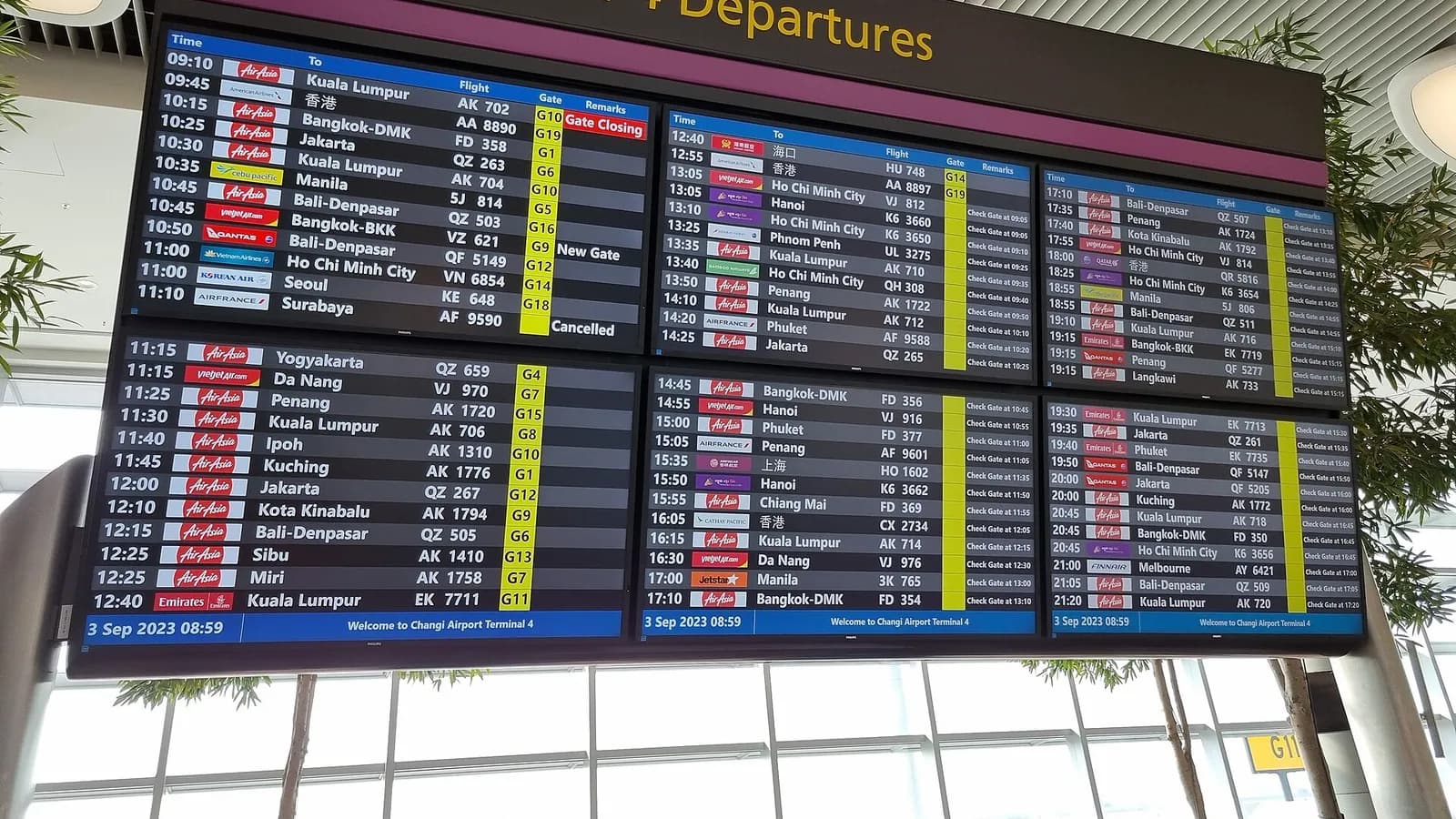
Not every airport change involves a cross-country journey. Bangkok has Suvarnabhumi (BKK) and Don Mueang (DMK). Tokyo travelers encounter Haneda (HND) and Narita (NRT). The city label can look almost identical in a search result, while the airport code tells a different story.
If you arrive at BKK and depart from DMK, that is still a departure from Bangkok, but it is not a same-airport connection. You need ground transport between two separate terminals in different parts of the metropolitan area.
For a journey spread over several days, this may be entirely convenient. For a same-day transfer, it changes how much time you need. The exact airport code is more useful than a vague promise that both flights are “via Bangkok.”
How the onward itinerary should read
A well-organized itinerary is surprisingly simple. Someone opening the confirmation should be able to see the passenger name, the departure airport, the destination airport, the date and the flight details without piecing together unrelated screenshots.
If your arrival and exit are on different bookings, keep both confirmations together. The arrival document explains how you got into the country; the onward document explains where you are going next. The cities between those flights are the journey, not a problem to explain away.
A reservation reference, often called a PNR, identifies the booking record. It is separate from an issued ticket number. The guide to checking a PNR covers what that code means and where it appears on a flight confirmation.
For trips with a fixed document check, the travel date on the itinerary and the period during which a temporary reservation remains active are separate details. You can read about that distinction in the reservation timing guide. There is no need to turn a route-planning article into a calendar puzzle; just keep those two dates straight.
Three routes, three different ways to finish the trip
The city-and-beach route: Arrive in Bangkok, travel north or south at your own pace, and fly internationally from Phuket. The departure airport follows your holiday rather than forcing your holiday to follow the departure airport.
The north-to-south route: Arrive in Hanoi, make your way through Vietnam, and leave from Ho Chi Minh City. This avoids retracing the entire country simply to board a flight from the arrival city. The broader guide to choosing an onward destination helps you connect the final stop to the next country.
The two-city Japan route: Arrive in Tokyo, explore Kyoto and Osaka, and depart internationally from Kansai. Compare the rail journey with the convenience of leaving from Kansai rather than returning to Tokyo.
All three follow the same logic: the onward flight should begin where the visit actually ends.
Before you settle on an airport
Look at the route as a traveler would, from the final hotel to the next destination. Check the airport code, the local departure date, how you will get there and whether the flight crosses the border. If you are continuing to another country, make that next stop part of the wider plan rather than an arbitrary dot on the map.
A different departure airport is not an unusual exception. It is often the most natural way to travel through a country without doubling back.